Investors sit through four, five, sometimes six pitches in a single day. By the time they get home, the decks blur together into a fog of TAM slides and hockey stick charts that all look suspiciously similar. If you asked most VCs to describe the last pitch they saw in detail, they’d struggle. Not because the founder did anything wrong, but because nothing in the deck gave their brain a reason to hold onto it.
Here’s the uncomfortable part: you probably spent more time on your deck than any other document in your company’s history. The fonts are dialed in. The colors match your brand. The transitions are smooth. And none of that is what makes a deck memorable.
What sticks isn’t polish. It’s specificity. And there’s one slide, if you build it right, that outlasts everything else in the meeting.
The slide everyone skips
Most decks follow the same skeleton: problem, solution, market size, product, traction, team, ask. It’s a fine structure. It’s also the exact structure every other founder that investor met this week used too.
Somewhere in that lineup, founders bury the one slide that could actually differentiate them: the “why now” slide. Not why the problem exists. Why it’s solvable right now, in this specific moment, in a way it wasn’t two years ago and won’t be as easy in two more.
Investors aren’t just betting on your idea. They’re betting on timing. A great idea pitched five years too early dies quietly. A decent idea pitched at exactly the right moment turns into a category winner. When you skip the “why now” slide, or worse, bury it inside your market size slide, you’re leaving the most persuasive argument in your whole deck unmade.
What actually makes it memorable
A strong “why now” slide isn’t a paragraph of context. It’s a specific, sharp claim about a shift, something changed in technology, regulation, behavior, cost structure, or distribution, that opens a window that wasn’t open before.
Think about it from the investor’s side. They’ve heard “the market is huge” a hundred times this quarter. They’ve heard “we have a unique team” from every founder who’s ever raised a dollar. But a crisp, well-argued case for timing is rare, because it requires the founder to actually understand the forces shaping their industry instead of just describing their own product.
If you can say something like: “This became possible eighteen months ago when X changed, and the founders who move first in this window will own the category,” you’ve said something an investor can repeat to their partners tomorrow without your help. That’s the actual test of a memorable slide. Can the person who saw your deck explain your bet to someone else in one sentence, hours or days later, without opening the deck again?
Most slides fail that test. The team slide doesn’t pass it. The product screenshot doesn’t pass it. A sharp “why now” almost always does, because it’s an argument, not a description.
Building it without sounding like everyone else
The trap here is dressing up a generic market observation as a “why now” and calling it done. “AI is transforming every industry” is not a why-now. It’s a headline. Every founder in every sector is currently using some version of that sentence, which means it does the opposite of what you want. It makes you forgettable.
A real why-now is narrow and specific to your business. Ask yourself three questions:
What changed recently that makes this possible now, specifically? Not broadly in the world. Specifically in your customer’s world. A new API became available. A regulation shifted. A cost dropped below a threshold that made your model viable. Distribution channels opened that didn’t exist before.
What happens if a competitor waits two years to enter? If your honest answer is “nothing, they’d be fine,” you don’t have a why-now, you have a why-eventually, and investors know the difference immediately.
Can you say it in one sentence that a stranger could repeat? If it takes a paragraph of setup, it’s not sharp enough yet. Cut it down until it’s a single, punchy claim.
Get this right and the slide does double duty. It shows you understand your market at a level deeper than your product, and it gives the investor something concrete to carry out of the room.
The mistake that undoes all of it
Here’s where founders sabotage themselves even after nailing the slide: they read it out loud, word for word, off the screen. If your why-now argument is actually sharp, you don’t need to recite it. You state the claim, then spend your verbal time defending it, why now specifically, why not six months ago, why not six months from now. That’s the moment an investor leans forward instead of checking their phone.
The deck’s job is to plant the claim. Your job in the room is to defend it under pressure. Founders who treat the deck as the entire pitch, rather than the opening argument in a conversation, are the ones who blur together by the end of the day.
One slide, not the whole deck
None of this means your problem slide or traction slide stop mattering. They still need to be clear and honest. But if you’re optimizing for what gets remembered after the meeting ends, the timing argument is where the leverage is. It’s the one place where good thinking beats good design, and it’s the one slide that turns “another solid deck” into “wait, tell me more about that.”
Most founders will keep polishing fonts. The ones who get remembered will spend that time sharpening a single, specific claim about why the window is open right now, and why it won’t stay open for long.
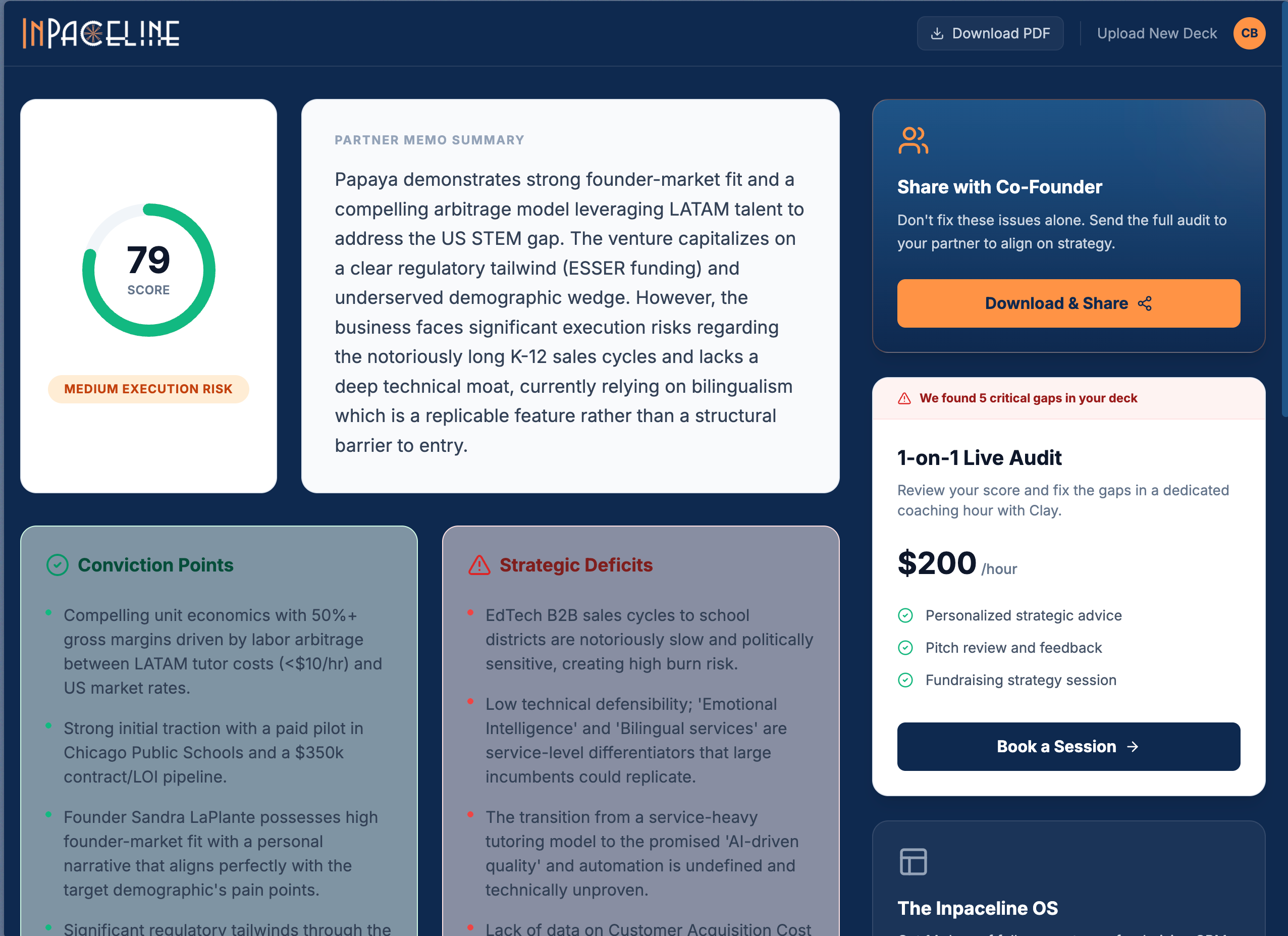
If you’re staring at your deck trying to figure out whether your “why now” actually holds up, Inpaceline OS includes a pitch deck analyzer built to stress-test exactly this kind of argument before you’re in the room defending it live. Run your deck through it at inpaceline.com and find out if your timing story actually lands.